A small pooja mandir in an apartment works best as a wall-mounted shelf, a corner niche or a closed cabinet in the north-east of the home, holding one or two idols, a brass diya, a small bell and a vessel for water or flowers — and very little else. Space is not the constraint people think it is; clutter is. Here is how to plan the placement, choose the type, keep it minimal and light it well, including options that need no drilling if you rent.
Which type of small mandir suits an apartment?
Most apartment mandirs fall into four types. Choose based on how much wall you have, whether you can drill, and whether you want to close it away when guests are over.
| Type | Footprint | Drilling? | Best for |
|---|---|---|---|
| Wall-mounted box mandir | Zero floor space; 45–75 cm wide | Yes | Living rooms and passages with a free wall |
| Floating shelf mandir | Zero floor space; one or two shelves | Yes | Minimal, modern homes; one or two idols |
| Corner mandir (floor or shelf) | A 60 × 60 cm corner | Optional | Using an awkward corner near the north-east |
| Cabinet mandir (with doors) | 45–60 cm deep cabinet | No | Renters; homes wanting it closed when not in use |
| Tray mandir on a console | A 40 × 30 cm tray | No | Studios, rentals, temporary setups |
Wall-mounted and floating shelves
A single floating shelf at chest height, with a second narrower shelf 30 cm above it for a framed image or a lamp, is the most space-efficient mandir there is. Choose solid wood or a laminate in a warm tone; brass looks better against wood than against white gloss. If the shelf is above a sideboard, the sideboard drawers become your pooja storage.
Corner mandirs
Corners are wasted in most apartments, and a corner shelf or a small triangular floor unit turns one into a shrine. Because two walls frame it, even a small setup feels enclosed and intentional. Corners also protect flames from cross-draughts.
Cabinet mandirs
A cabinet with doors — an old almirah section, a bespoke unit, or even a repurposed bookcase with a curtain — lets you keep the mandir private and dust-free. This is the most renter-friendly permanent-feeling option, since it is furniture, not a fixture.
Where should the mandir go? Vastu placement in a flat
Vastu places the mandir in the north-east (Ishan) corner, with the idols facing east or west so that you face east or west when you sit for pooja. Aim for that first. In apartments the north-east is often a bedroom or bathroom, so the widely accepted fallbacks are the east or north side of the living room. A few practical rules hold whatever the direction:
- Do not place the mandir against a wall shared with a bathroom, or directly under a staircase.
- Keep it off the floor — a shelf or plinth at or above knee height — so idols are never at foot level.
- Avoid the mandir facing a bedroom door directly; a light curtain or cabinet door resolves this.
- Leave enough clear floor in front for one person to sit or stand comfortably.
Our full guide to pooja room direction and Vastu covers the reasoning, idol orientation and what to avoid in more detail.
What should I keep in a small mandir — and what should I leave out?
The single biggest upgrade to a small mandir is removing things. A shelf with one idol, one lamp and one bell has more presence than a shelf with nine idols, three framed prints and a plastic garland. Pick a centre — a brass Ganesha, a Lakshmi, a Shiva lingam, a framed image of your kul devta — and let everything else support it.
The essentials
- One or two idols or images — the focus of the space.
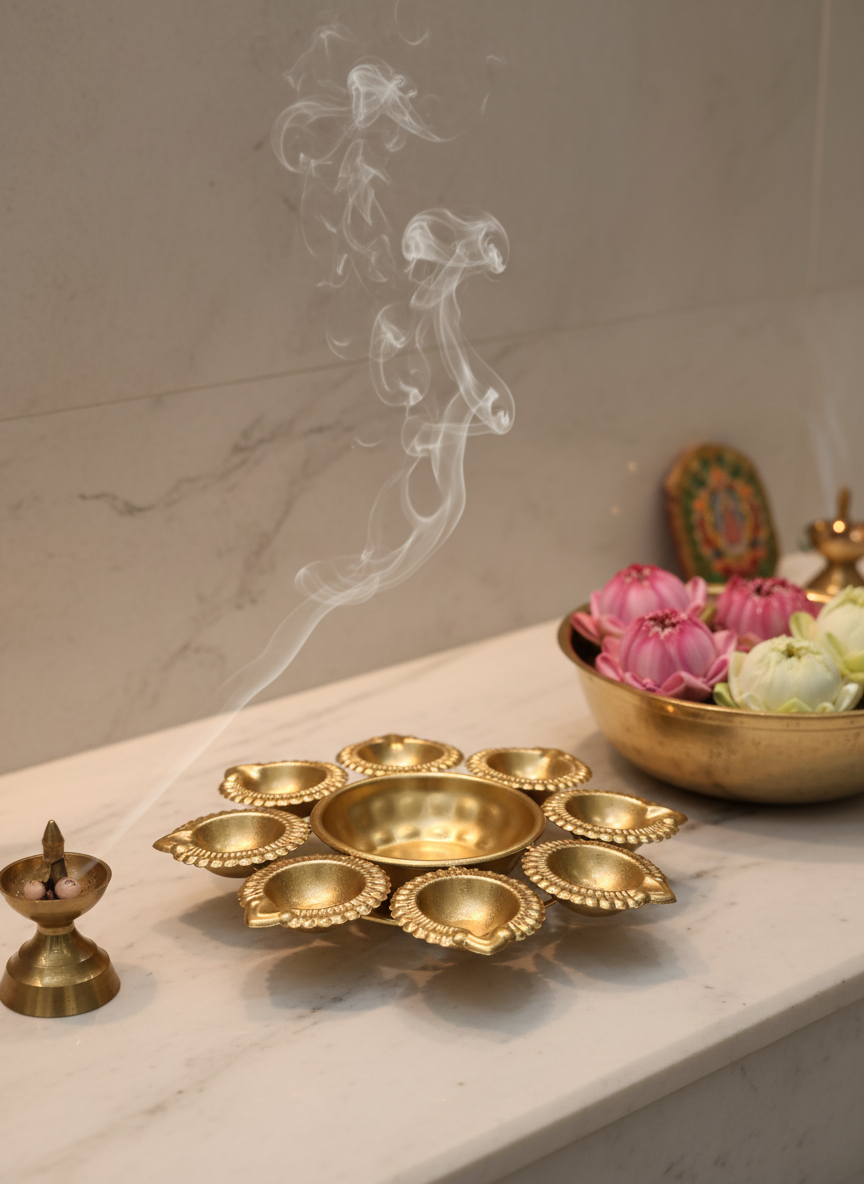
- A brass diya — a compact brass oil lamp; the Handcrafted Brass 8-Wick Lotus Oil Lamp (₹349) is small enough for a shelf and steady enough for daily aarti.
- A small brass bell — rung at the start and end of pooja.
- A vessel for water or flowers — a mini urli or kalash; a lotus-shaped brass urli (₹999) holds a few floating flowers on a shelf without spilling.
- An incense or dhoop holder with a catch for ash.
- A tray to hold it all — it defines the sacred boundary and makes cleaning a lift-and-wipe job.
What to leave out
Duplicate idols of the same deity, decorative items that are not used in worship, plastic flowers, and anything that blocks the front of the idols. If a piece has sentimental value, keep it in a drawer below and bring it out on festivals.
A mandir is not measured in square feet. It is measured in how easily you sit down in front of it every morning.
How do I light a small mandir well?
Lighting decides whether a shelf reads as storage or as a shrine. Three rules: warm light only (2700K or lower — no cool white), light from above and slightly in front, and the oil lamp as the living centre. A slim LED strip under the shelf above the idols, or a small plug-in puck light, gives the everyday glow; the brass diya gives the flame. For an enclosed cabinet, a puck light on a timer means the mandir is lit at dawn and dusk without a switch. Brass and copper come alive under warm light and go grey under cool light, so this one choice changes how every piece looks.
Where does everything get stored?
A mandir needs more consumables than people expect: oil, wicks, matches, camphor, incense, kumkum, a cloth for wiping, spare bells and festival items. Plan storage in the same footprint as the mandir — a drawer beneath a wall unit, a sideboard under a floating shelf, the lower half of a cabinet mandir. Keep oil in a lidded brass or steel container to stop leaks, and keep a small tray for used matchsticks and ash so the shelf stays clean.
- A drawer organiser with sections for wicks, camphor and kumkum.
- A lidded jar for oil and a folded cotton cloth on top of it for daily wiping.
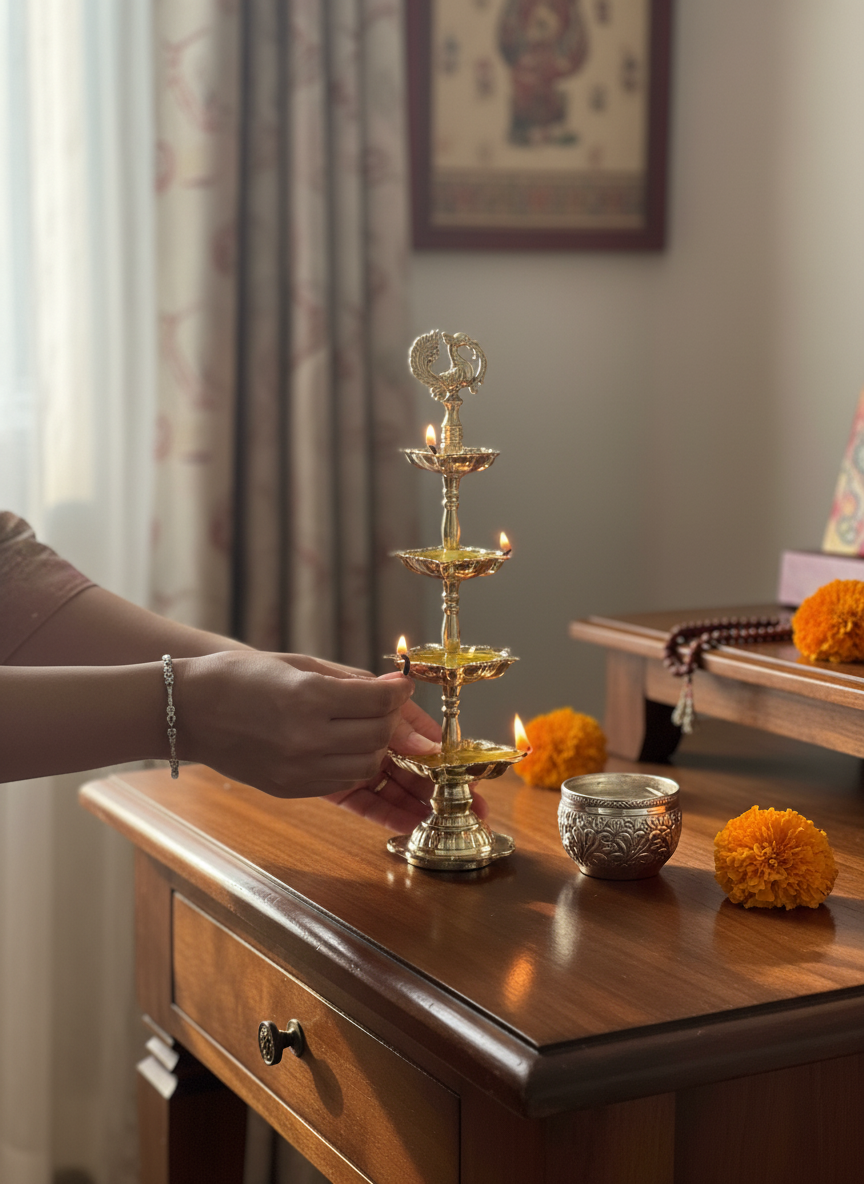
- Festival brass — the bigger urli, the tiered lamp — wrapped in cloth in the lowest drawer.
What are the best renter-friendly mandir ideas?
If you cannot drill, you can still have a complete mandir. The simplest is the tray mandir: a brass or wooden tray on an existing console or bookshelf, holding one idol, a diya, a bell and a small urli. Lift it, wipe the console, put it back. A freestanding cabinet or a narrow bookcase turned mandir works too, and adhesive LED strips light either without wiring. When you move, the tray goes into a box and the mandir is set up again in ten minutes. A small set of brass decor pieces on a tray is often more coherent than a built-in unit filled over years.
How do I make a small mandir look modern, not dated?
Use honest materials — solid brass, unglazed wood, stone, hand-thrown ceramic — instead of gold-painted plastic and printed laminates. Keep colours to two: the wood tone and the brass, with fresh flowers as the only bright note. Hide wires. Choose a few well-made pieces over many small ones. Our piece on the pooja room reimagined for modern homes goes deeper on the design side, and everything for the shelf — lamps, bells, urlis, idols — is in pooja room essentials. Orders above ₹5,000 ship free; below that shipping is a flat ₹99, with Cash on Delivery available.
Frequently Asked Questions
Where should a small mandir be placed in an apartment?
The north-east (Ishan) corner is the traditional first choice, with the idols facing east or west so you face east or west while praying. If the north-east is taken by a bathroom or kitchen, the east or north side of the living room is the usual fallback. Avoid placing it directly against a bathroom wall or under a staircase.
Can a pooja mandir be in the bedroom or living room?
Yes. In most apartments the living room is the practical choice, and a small wall-mounted or shelf mandir there is common. If the bedroom is the only option, keep it in a dedicated corner, cover it with a light curtain or cabinet door when not in use, and avoid placing it at the foot of the bed.
What are the essentials for a small pooja mandir?
One or two idols or a framed image, a brass diya, a small brass bell, an incense holder, a small vessel for water or flowers (a mini urli or kalash), and a tray to hold them. Everything else — extra idols, decorative items, framed prints — can be left out without any loss to the practice.
What is a good renter-friendly mandir idea?
A tray-based mandir on an existing console, a freestanding wooden cabinet, or a tension-mounted shelf. These need no drilling and move with you. A brass tray with a diya, a bell and one idol reads as a complete mandir without a single hole in the wall.
How do I light a small mandir without a ceiling light?
Use a warm-white (2700K) LED strip or puck light under the shelf above, angled at the idols, plus the oil lamp itself. Avoid cool-white or blue-toned LEDs, which flatten brass. A small plug-in spotlight on a timer works well in a cabinet mandir.
The umsang Studio
Handcrafted home decor, made by Indian artisans.